
Transcript
Announcer:
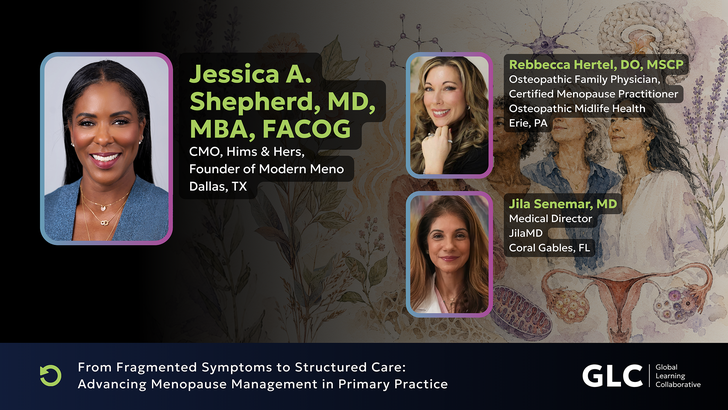
You’re listening to GLC on ReachMD. This activity, titled ‘From Fragmented Symptoms to Structured Care: Advancing Menopause Management in Primary Practice’ is provided by Global Learning Collaborative.
Prior to beginning the activity, please be sure to review the faculty and commercial support disclosure statements, as well as the learning objectives.
Chapter 1: Assessing Impact and Structuring Conversation
Dr. Shepherd:
Good evening, everybody. I'm Dr. Jessica Shepherd, and I have my wonderful panel here, which are full of colleagues and friends. And we have Suzanne, who's our patient advocate. We have Dr. Rebecca Hertel who is here, and we have Dr. Jila Senemar, who is also here.
What we have seen in the last 22 years since the WHI. Raise your hands if you're familiar with the WHI study. Good, because this is the only time we're going to mention it tonight. Okay, great. Alright, so now that we are 22 years past the WHI and we really are entering a new frontier into how we approach women who are going through midlife, whether that's through the perimenopausal journey or menopausal journey, is now that we had the worst PR campaign for women's health, women typically are going to be a little hesitant, feel awkward about asking the questions when it comes to menopause, but they actually may not know how to put the pieces of the puzzle together, so they may appear with more category of symptoms rather than saying, "I may be in this transition." So that may appear something where it's their sleep pattern that's disrupted, their cognition. I can even say very transparently between my colleagues and I, the 3 of us today, we had a lot of cognition issues while we were eating lunch. I'm not even sure if we remembered what we ate, how we got there, but we are now here sitting in front of you. And also-- we did it. Between 3 physicians, we were able to get through our cognition limitations today and make it here.
And then quality of life. For me, I think you know quality of life is probably one of the biggest things that if you take any of the—they say there are 34, which I would probably argue there's more symptoms of perimenopause—is if you can categorically place that into a sentence for a woman because their symptoms will be all different, bringing the quality of life factor into it actually makes it much more tangible for that patient to understand where they are and why that's so important for them to honor that because it's now impacting their quality of life because that is different for everybody.
So when we think of useful models and clinical aspect and how we relate that to the patient, it's not a single case explanation. Actually, this is what makes it a little bit difficult for the transition for women going through midlife, how they enter perimenopause, what they know about it, how aware they are, or even from their own perspective what they're willing to do once it's realized.
And even for Suzanne, do you have your mic with you? I wanted to give you actually just an opportunity as we look through this connection between menopause, you'd shared this with us as we were talking outside, can you give us just a brief synopsis of how that started for you early on?
Suzanne:
Yeah, so it probably started in my late 30s, I just started getting a little hotter, and not really the good kind of hot. It was just all of a sudden I felt like drying my hair or some type of trigger created- you know I wouldn't consider them hot flashes, but it was something that was like this is just not normal, and constantly having to regulate my body temperature. But I didn't really relate it to anything. I didn't connect the dots at that point.
Dr. Shepherd:
And then moving forward into when you had a medical condition, can you explain the medical condition and then just the first part of the story? So we'll give them a little bit of FOMO. The first part of the story when you first realized that maybe something was awry.
Suzanne:
So to make things a little bit more complicated, I inherited a genetic blood clotting disorder, the protein C deficiency, and through that spent you know a couple of years trying to figure that out and figure out how to manage that. And when I finally connected the dots with maybe I'm having some hormone issues, there really was no support, so I couldn't get the coordination between my hematologist, my gynecologist, and my family practitioner to tell me what to do. So there was a lot of a lot of years there just kind of waiting and figuring out what direction do I need to go in because they weren't able to come to a conclusion.
Dr. Shepherd:
Yeah, and that's exactly what you just said, it’s probably what most of our patients will present with many years going through understanding is this, isn't this, is this severe, and maybe talking to friends or not, and trying to put the pieces of the puzzle together. So that may be years that a patient may finally have the whether it's bravery, courage, ability to put the pieces together to actually present to a clinician and say, "This is what's going on."
So the slide that's up right now on the far left is looking exactly at why Suzanne's experience was like that because of the ovarian hormone change. Now, we know this from a physiologic standpoint that typically we start to see decrease in progesterone first. Testosterone also starts to take a decrease in your mid 30s, and then estrogen obviously on the slow decline with a chaotic appearance through the perimenopausal timeframe until it decreases enough where follicular activity is then no longer there, and that again would be the absence of menses for 12 months consecutively, right? So that's a little troublesome for some women who may go 10 months and then have a cycle, or they go 11.5 months and then have a cycle. So that's what we say in the clinical world of what constitutes menopause. But before that can be that chaotic time frame of 4 years to even 10 years before someone really has that complete decline in estradiol.
So we are going to look at different topics between the 3 of us. But for me, I really wanted to focus on sleep and where that kind of resonates in the brain health conversation because that sleep I would say is the umbrella term that patients will present with, disruption in sleep. A disruption in sleep can really signify so many different things, whether that's they are waking up because there is a hot flash, right, or a night sweat. And so that would be more of what we would see in the estrogen or estradiol disruption versus progesterone may not allow them either to fall asleep or not have very calm sleep, restful sleep. And with that is really listening to more of the story and how women present because sleep really does have a very, impactful- I guess, impactful use for women not only in the timeframe of quality of life. Remember, we brought that up earlier but also long-term health implications. We know that with disruption of sleep, there is going to be increased risk for cardiovascular disease, as well as what we are now seeing in the data towards dementia. But from that, the consequences from poor sleep means that there's the disruption of their daytime schedules, as well as cognition. So it really becomes this flow chart in how we identify the situation, assess it as clinicians, because that's what our job is, right? That's what we do really well is being able to assess that, but then also hearing the patient, so we can clarify and quantify where the disruption is, and then leading into the treatment, at which we'll go through as well.
So the important part for all of this is to how do we see patients when they walk in, and that really is creating the safety for them to express what they're doing, normalize it because they typically will feel like they are the only one that is going through what they're going through. And so, when you can create the safety for them to understand that women are going through this, it's very chaotic, that is validating the issue and then inviting them to tell you more about the story so you can do better management.
So, disclosure before diagnosis, asking them where this ranks or rates for them as far as a challenge in how they notice that in their day-to-day, and then clarifying. Just as we were talking with Suzanne outside you know, between the 3 of us, we were badgering her with questions because that's what clinicians do. We just like to ask so many questions. But in the asking of the questions was getting clarification. Clarification of when it started, when it ended, what was the intensity? How did that increase? Making that connection. I'm sure between the 3 of us, we all had different ways of managing that and what that would look like in each of our own practices, if she were to walk in each of our separate practices. And then creating that function in treatment. So it should be shared decision-making. That's going to change the conversation.
This is very different to how we typically treat hypertension or diabetes, where we're very driven by the lab, and what the lab shows how we try to bring more clarity to the outcome of the lab. Right? It is very difficult to treat labs when it comes to hormones during the perimenopausal transition because every woman will show up with a different version of what those labs will look like when we look at. FSH, typically is the one that can be diagnostic of menopause, but in perimenopause, estradiol, your progesterone levels, testosterone levels, and also AMH, those will start to fluctuate. So it's not lab driven; it is more experiential, and that's where the conversation makes all of the difference in how you make the decision, or allow the patient to make the decision with your direction.
So moving from symptoms to meaning is basically saying the same thing in how we're making those symptoms a part of the assessment, and then from the assessment is going to reflect back. We even were talking about this again. Clearly, we were just talking outside nonstop, but we were talking about some of our own symptoms. You know I think that's where this transparency has gone, in being able to share our own trials and tribulations with perimenopause symptoms is that we were able to say, Oh, well, if this is starting to happen now, maybe we should look at your levels of what you're taking and increase them in order to offset the symptoms that each of us have from day to day, including cognition at lunch.
I am going to go through some of my slides a little bit faster because I have the most, but I do want everyone else to be able to speak. This slide right here is very important because the review of symptoms is going to be paramount for women going through perimenopause, because as they're going through those fluctuations, they will only continue to change as they go through that getting closer to menopause.
The best way I can explain this is I use this analogy all the time is the gas tank analogy. And in the reproductive years, our hormones, namely estrogen and progesterone, and even testosterone, are what you'd consider maybe full tank, and as we start to go through perimenopause, that's when we start to waver, maybe to 1/2 to 1/4 tank. And they're never going to go back up; they're only on their way down. And so with that decrease in the gas tank, namely for the hormones, is the symptoms will start to either escalate, increase in frequency, duration, how the patient experiences it, and even adding on some of the symptoms that maybe they didn't anticipate. So as that gas tank starts to decrease, our goal is to assess the patient and prioritize which one for you is maybe bothering you the most, when we think of quality of life and disruption. And that requires follow-up because some of those options in management are going to change when we look at hormone therapy or even non-hormonal therapies as well.
So, for this case presentation, you can see that we have a 49-year-old executive who now presents with sleep, cognitive, quality of life functions. And because of her role, you will see a lot of women in mid-age, this is when they're starting to see their careers peak, high functioning, a lot of responsibilities as far as delegation and project management, and the changes start because there's decrease in sleep quality and quantity in waking up at 2-3 AM. Now, difficulty falling back asleep and increasing brain fog and trouble finding words, and more fatigue throughout the workday. Obviously, more fatigue because this patient is not getting a good quality of sleep. So the impact now, when we think of quality of life, is now having to spend more time with menial tasks or reread emails, losing your train of thought in meetings, and less patience at home. We're not going to do a show of hands who has that one. And then also relationships as well.
So a practical visit, what this might look like in my practice is looking at what has changed, which we saw in the last slide, and how our workflow goes. So now we can screen that with sleep patterns, any vasomotor symptoms that they may experience in the middle of the night, being able to quantify that. This is how you can have patients start to track those. Whether they're using an app, an app is a great way for them to get really good data on themselves, and then having cognition, which we went through in the last slide.
So, in context, you still want to make sure that everything isn't going to be attributed just to perimenopause and menopause, and that's again the strength of being a clinician and being able to say what other things might be relevant that we need to work through, whether it's a thyroid issue, whether it's a very high stress environment that's causing that. And I think that that should never be taken out of how we assess patients as well. So the plan should be: What does this mean for you? What are you willing to adhere to, or maybe take? And following up. So putting the patient's prioritization and goals back at the top of the at the list is more important than what we would think is more important for them. That's true patient autonomy, and I think that that is a difference to again how we manage some of these more severe diseases of hypertension and diabetes, and the list goes on and on.
So this was validating tools. There are a lot of tools. I would say that probably the best tool that I give patients now is actually through wearables, because then you can use that data to kind of have some very strong points that's going to be consistent, and the patient really doesn't have to do that much as far as getting the data.
So these are treatments. Everyone in here is going to have a different variation of what that looks like, especially with the patients that you have. Some patients are very amenable to hormone therapy. Some are not. Some still need time. Some are willing to look at supplementation. I believe that lifestyle interventions should categorically always be the founding portion of what patients really need to prioritize, because we want to build a house in the midlife, which we want to decrease chronic disease in the future, but lifestyle interventions are probably very important. And hormone therapy, even though I'm the biggest advocate for hormone therapy, I also have to respect patients who desire to take non-hormonal therapies. And we actually are at a day and age where we actually have some on the market, which is very different to what we saw years ago.
So for me, these are the key takeaways, and it's not necessarily just for sleep disruption, I just focused on that because I really do find that that's maybe one of the things that are not paid attention to, and one of the symptoms of menopause that are not looked at as maybe one of the most important. But in the key takeaway is understanding quality of life factors, how that impacts that patient, understanding that this is a very chaotic timeframe in a woman's life, and most of these symptoms are going to have complexities to them, and then allowing the patient to be part of the decision-making.
Chapter 2: Navigating Treatment Discussions and Shared Decision-Making
Dr. Hertel:
Good evening, everyone. Thanks for being here with us. And so I'm going to take a little different approach here, and we're going to talk about treatment and shared decision-making with your patients.
And we are going to talk about the patient who comes in with printouts. How many of you here have had your patients come in and they have read something from social media, they brought their phone in, they have a list, and they are telling you, "I read this on social. I saw this from my favorite person, my favorite influencer," and you have to decide what to do with it, right? So I think it happens every day.
So in this visit, we have a 51-year-old woman. She's here for a follow-up, but you're talking with her, and she talks to you that about her hot flashes and night sweats. There's 8 to 10. They're disrupting her sleep and her concentration at work. She's not as productive. You did discuss hormone therapy last time, but she decided not to. So she opens her phone and shows you a video and warning that hormone therapy is going to cause cancer. But the new hot flash pill with no hormones causes liver failure. So what are we going to do with this?
So when you're talking with patients, you know I really want to focus on not what is the right thing, like not which drug is the right drug to use, but really structure the conversation around what she's holding in front of you, the fragments of information that she's holding in front of you, right? So this is, let’s make sure that you're addressing the real data, that you're taking it into context, because she's afraid. She doesn't know what to believe. She's not sure what's real. She's seeing all of these things online, and she’s afraid that she's going to trade one risk for another.
And in addition to this, this is the information that she's coming from, right? One in four women age 40 to 49 use online platforms to look for their perimenopausal information. Sometimes I think it's more than that in my practice, to be honest. So, you know so and misinformation, of course, runs in both directions, right? So we have hormones can cure everything, and then we have the that the WHI information they're still scared that they cause breast cancer and they're going to get breast cancer from hormones.
So you really have to navigate the truth, and meet them in the middle, and really have a great shared discussion in the small amount of time that you have about what they're feeling, validate their feelings, but then really give them the data behind that. So, your job there, when you're sitting with them, is not really to compete, but to give them framework for which to make the best decision for themselves. And it's not going to be necessarily our decision, right? But you have to give them enough information so that both of you can come together and choose what's going to be best for her. And sometimes the first choice isn't going to be the choice that she ends up with in the end.
So we'll talk a little bit about what the evidence supports. The 2023 North American Menopause Society, now the Menopause Society, talks about the different types of level of evidence here. And I'm not going to read this to you. You can see that there are different non-hormonal medications that we have for level 1, and level 2 as well, and then the things that aren't recommended. So it's not that there's hormones versus nothing at all; we really do have a nice array in our toolbox or in our clutch bag, I like to say, of things that we can give women to use.
The biggest thing with these medications is that I really want to discuss what happens with them. So as estrogen declines, that disinhibits these KNDy neurons. And those KNDy neurons, the kisspeptin, neurokinin B, and dynorphin, they're in the hypothalamus. And unopposed neurokinin B signaling at the NK3 receptor destabilizes that thermoregulatory center, and so then we feel hot flashes and night sweats. So essentially, it's a lot of words, but what happens is those small changes in temperature makes us feel like we are having astronomical changes in body temperature. And I can attest to that because I had one of them right outside there while we were talking.
So here again, there are 2 different ones, the fezolinetant and elinzanetant. One is a selective NK3 antagonist; the other one is a dual NK1 and NK3. Again, you can read through all of this, and we can answer questions in the end. Same mechanism, different receptor. Head-to-head trials data do not exist yet, so if they ask those questions, you can tell them there are at this time no head-to-head trial data. But just present indirect comparisons for both of them; that they have 2 separate options.
And same thing here with the fezolinetant. Again, as you guys know, you got to make sure that you are doing baseline labs: 1 month, 2 month, 3, 6, and 9. And with the elinzanetant, we talk a lot about the somnolence or feeling tired when they're using the elinzanetant.
So when you're talking, I think really for this slide, what I want you to focus on is they're going to ask about liver and they're going to be very scared about that. So you need to make sure that you're discussing the side effect of, listen, we're going to do baseline labs. We talk about statins. We do baseline labs there. I can tell you, in almost 20 years of practice, I've maybe have a handful of patients where I've seen rhabdo and liver issues with my statin patients. So you're going to counsel the same way that you would. Okay, talk about that we're going to monitor. We're going to monitor frequently, and if we need to discontinue, then we will.
I think to really validate that they're not wrong to be worried. Right? These women come in and they're scared, and they're not educated about all of their options.
Although some of them are going to come into you, and they're very educated, and they're probably going to teach you something, and that's okay too. It's about how you are having a discussion with them, and I think the key word is with. You're not talking at them, but you're having a conversation with your patient. So, just like you're going to talk to them about their- about breast cancer risk with your patients, and you're going to go over individual risk factors, it's the same thing with talking about some of these other medications as well. So, again, validate that hormone therapy risk is small, time, context dependent. You're going to talk about risk factors. Non-hormonal does not mean risk free, and I think that's really important.
Same thing with when we talk about supplements as well, right? How many times do we have patients we have no idea what they're taking, their liver function is off, and they bring in their bag of supplements that they've been taking.
So a lot of times want to make sure that when we're talking with these- with our patients in general, you know we talk about a really good risk-benefit discussion between all of the options that she may choose, and that's where the focus on this slide comes to. Validate the instinct behind the concern before correcting the facts. Don't be so quick to just correct her but validate what she's- what her concerns are. And she's not wrong to want to understand. She's working from a decontextualized version.
So we're going to go through all of the this visit flow again, which I agree, this is exactly what I do as well. You know Tell me what's been going on. What have you been feeling? When did this start? Same thing, you- and then you go down to the screening: sleep, vasomotor symptoms, cognition, mood changes, function. Can you- Are you able to remember the things that you're wanting to remember? Or do you get to a boardroom and you forget what you're going to say? Do you walk in or out of the room and completely forget everything that you were supposed to take with you? Did you forget your children, to go pick them up or to drop them off? That may or may not have happened more than once, actually.
And then take it into context: medical history, the menopause stage, medications, their lifestyle. And I echo you know what Dr. Shepherd had said up here too: lifestyle is so important. It's the one thing you know all of my patients need to make sure that they're changing, is their lifestyle as well if they need to change it.
Assess, use your tools. I like the wearables as well. I do like the Greene Scale score as well. And the reason I use that score with my patients is because it gives them a number, and when they come back, you know women we like to just focus sometimes on the bad things. We don't, you know, maybe we fix something and then we're like, but this is still not right. And so that score when you can say, hey, you went from a 25 down to a 10, that was progress.
And then again prioritize their important goals, make the plan together, also, and let them know that what you start with doesn't have to be what we end with. We can always try things out.
And then reassess. Please don't let them go for 6 months without seeing them. I like to see my patients typically 6 to 8 weeks because I want to make sure that what we started is still working and that they're not having any side effects.
And so the key takeaways here again: clinical data on the neurokinin target therapy. Patients are not wrong to come in with questions, and making sure that you're having a structured, honest conversation about options. I know you don't have a lot of time to do that, and so you want to make the most out of the visit.
Chapter 3:Individualizing Counseling in Complex Contexts
Dr. Senemar:
Alright. So I'm going to start with a question with Suzanne. I know putting you back on the spot because it ties into what we're going to talk about here. Can you explain your journey? Like what happened? You figured out something was wrong, you went to your doctor—just explain what you told us outside.
Suzanne:
Sure. So it was you know over several years. Like I said, it took me a while to connect the dots because things kind of happened incrementally over time. And when I got to a point, and so now I've already had the protein C deficiency diagnosis, and I'm you know doing well with that, I started to feel just really different, and not really sure exactly what to do. And it almost felt like it was overnight for me, where probably 5 years or so ago, like I just was—I went on a vacation, came home and felt like you know maybe I have COVID or something is wrong. And I went to, you know- I just happened to have my annual appointment and I went and we decided to do a hormone test. It wasn't even on my mind at this point, and so when she told me that we need to do some labs, it came back and said, well, you basically have nothing, you know like I have no hormones at all. I thought, well, maybe that's why I feel different. I was just exhausted and really couldn't get throughout the day.
And so at that point, you know we talked about my protein C deficiency and not able to take any oral HRT. And she mentioned that there was new research that said topical could be okay. And so she actually went and did a bunch of research, and she printed out a bunch of articles. So she actually did it for me, but she printed out a bunch of articles for me to take to my hematologist. And at that time, when I- because I was also just recovering from a pulmonary embolism at that time, so it was a pretty sensitive time. I was you know still not feeling great about other things. My body I think was still recovering. And my hematologist basically said, you know when I gave her the materials, you know said, “You can go find a doctor who will tell you whatever you want to hear…but I don't approve,” and so that kind of just—you know I waited another year, and came back. And the whole time, my other doctors were continuing to say, “We think that you could probably do this,” because I was suffering. But it was the sleep was probably my biggest issue because I was having hot flashes at night and not sleeping every night.
And so when I went back for my next year, and I asked again, like, what do you think now? It was kind of this, oh yeah, no problem, no big deal.
Dr. Senemar:
But you already lost a year in this time, right? Yeah. Three different doctors, and finally, somebody gave you something.
Suzanne:
Yeah. So I was nervous too I was, you know- because I was, I wanted to follow the doctor's advice. I didn't want them to feel like I'm trying to like go Google my own treatment.
Dr. Senemar:
So that's what we're going to talk about: individualizing the counseling in these complex cases. It's not easy. She has a medical condition, quite severe, but there's data on it, and we have it, and we can actually use it. So it's individualized care, individualized treatment. But you have to know the history, and talk to your patients. It's all about shared decision-making. So you know, just saying, “My mom had breast cancer,” and so you have to personalize the treatment. What is the fear? Your mom had it. When did she have it? Was it genetically driven? And what happened next? Those are all questions that we should be really discussing with our patients.
Our patient here, 53 years old, hypertension, and she's here for a follow-up. She mentions she's getting some night sweats here and there. And you know when you ask further, how are you sleeping? “Oh, you know she didn't ask, so she's like, well, I guess I'm okay, but I get about 10 hot flashes a day. I soak through my clothes 3 or 4 times a night. I'm snapping at everyone, and sex is uncomfortable. But because of my mom, I am not putting hormones in my body.” This is what we you know that- this is what women are coming in with.
And if you really then ask more of the history, last period was over a year ago, so 14 months ago. Mom's history, breast cancer at 64, alive, genetically negative. No other relatives are affected. Blood pressure is well controlled. BMI is 32. Hemoglobin A1C 5.9. She drinks 1 to 2 glasses of wine a night. Okay, but no clotting history. No history of migraines. No liver disease. Basically, a normal mammogram. This is typically what we see. This is not a one-sided conversation. This is you know history, and we need to ask.
Three questions. These are the things we should be asking: She's 53. She's 14 months past her last period. She's menopausal, right? But she's under 60, so she's within the 10 years of being able to use hormone therapy, where the risk-benefit ratio is in her favor. And the risks are one relative diagnosed after menopause, gene negative. So her risk is modest, but it's not high. And her blood pressure, BMI, those are not contraindications. They just decide the route that we're going to use. And no clotting, no migraines, no liver disease, no unexplained bleeding. Why do we keep saying this? These are your contraindications. Because mostly 9 out of 10 women are candidates for hormone therapy, unless it's one of those things. And even then, you really need to look deeper before saying no. It should never be no. It should be let's talk about it.
And what are her goals? What is she here for? Her priorities are sleep. Like Suzanne, she wasn't sleeping, and we talked about sleep, cognition, impact of quality of life. So, her priorities are sleep, then her mood, then her sex. “Nothing that raises my cancer risk,” that's what she says to you. She wants something that she can stop easily. Okay. Her mammograms are going to stay on top. And now we want to ask, what would you offer her? Do we have any answers out there? Do we- We don't have Clara. Okay, so we'll go. We'll go into it. Alright.
This is a way to address her risk factor to her. Numbers can actually- these are what we can use. Without hormones, 23 out of 1,000 women her age might develop breast cancer over the next 5 years. Just, with combined hormone therapy, 27. So 4 more. Now let's talk about her risks. She takes hormone therapy, maybe +4. Those drinks that she has 2 a night, that's a +5. So that's actually adding more to her risk than her being on hormones. And her BMI of over 30 actually adds more than her being on HRT. So again, we talk about women wanting data. This is data, okay. And her mom was one relative, roughly that decides that maybe doubles her risk of starting hormones, but the same 4 on top that double it. It doesn't double it again. It just adds to it, so family history should not be a contraindication.
So, the case is introducing you know the landscape. Like, we have to be reasonable. If she chooses to decide to start hormone therapy, the patch is usually something transdermal. Patch. We have a cream. We have a mist, we have a gel, we have vaginal ring. So we have all varieties. I mean, there's a patch shortage, but again, now we have gels, right? And now there's a gel shortage, but again, we'll figure that out.
The right route for her is really the you know based on her symptoms, her blood pressure, her weight, and the progesterone is what's going to protect the lining of the uterus. So the best breast safety data is on oral micronized progesterone. So again, more information to provide her, and so it's going to be effective treatment for her hot flashes, for her sleep, as well as vaginal symptoms. And then, if those symptoms aren't improved, you can still add localized vaginal estrogen to her regimen.
So that's one side of it. We could do this. Now she says, "I want non-hormone therapy." We talked about that. We talked about the NK1 and NK3 receptor antagonists. They're great for hot flashes, and they're good also sometimes for sleep as well. So they need liver monitoring, yes. But again, we have non-hormonal therapies. We have gabapentin. We have cognitive behavioral therapy for hot flashes. We have different doors per se for her to walk through and decide where she lands. And vaginal estrogen should be a part of the conversation whether she goes on systemic hormones or on non-hormonal therapy.
So how do we say it all in a real visit? In 5 minutes, 10 minutes, how do we explain all of this to her? Right. It's fast, so you have to really be ready. What I think we're seeing a lot more in the com in in the atmosphere out there with women is they're coming in educated, they come in with a list of questions and they come in with their concerns. So really, it's making it more you know time worthy to just kind of what are the priorities, what's happening, what are we going to work with? And let's try and get to the bottom of it. And you know validate her first. You have to listen. You have to get the story. Once you get that, then you know where to go from there.
You watched your mom, you tell the patient, go through breast cancer, of course, that's we know where your mind is going go, but let's talk through it. Let's talk about your individual risk and how that's going to be impacted, whether and if you decide to start hormone therapy. The visit you know, it doesn't need to be a 40 long minute visit. I mean, although some of us do that, but you don't need that. You can follow. And we have all varieties, which we've heard all this. Take a picture of it because this is literally, we all pretty much—it's very straightforward. Transdermals, non-hormonal. Then you have the antidepressant, and you have vaginal estrogen. That should be a part of every conversation with every patient. It's a preventative mode. So you know rank her symptoms, pick what we want to target, and then acknowledge, move past it, decide what she wants, and then follow up with her.
Keep a symptom diary. I want you back. I do the same, 6 to 8 weeks until we have them on their regimen, then we can space it out a little bit. But to just hand them a prescription and send them on their way, it's not going to work because they'll come back and 9 out of 10 times they never started it.
Going back to your clinic, 3 things to take back with you, right? Family history is a reason to dig further and ask more questions. The comorbidities may affect her hormone therapy, but not whether she should use it or not. They're just part of the conversation and her risk assessment. And then a checkpoint. This is where we need to dig in and ask. Tell her what the relief can look like, what to expect, when to expect it, and come back so we can change and you know titrate your dose as needed.
Suzanne:
So I'm actually here representing the National Menopause Foundation, and I want to you know first really thank everybody in the room for being here because me being the patient advocate, you know I've recognized that this is important time for women that we're starting to clear things up and actually shine a light on a problem that I think many of us have had but had no support. So thank you all for being here.
And one of the things that I would mention too is that everyone's talked about that women are becoming more educated, and they're bringing in the articles, they're bringing in you know the things that they're learning, and that it increases the amount of bad information that's out there too. So my, you know my algorithm on all my social media platforms is trying to sell me everything and anything about perimenopause and menopause. And it can be- it can feel chaotic with you know what are we supposed to do?
And I appreciate organizations like the National Menopause Foundation for being a source of truth and for being passionate about going to D.C. and advocating for women's health and you know we're starting to see- we know we heard the news today about the executive order on increasing the focus on women's health. So I really appreciate being part of this organization.
And they have a lot of great tools. If you want to go to the next slide. I believe that there are some handouts here potentially that will that you can utilize. But they have a lot of fantastic, great resources, and I believe there's also a QR code that you'll be able to scan on one of these other slides. But I think that is one of the important things for your patients is to be pointed to sources of truth that can be trusted to reduce the amount of confusion out there.
And I think the doctors did a really fantastic job of kind of weaving my story in throughout the actual presentation today. All I would say is that for me there was the you know they talk about the cone of chaos or the confusion, and I did experience that for many years where I didn't connect the dots on what was happening, and a lot of it was because it was we were going through COVID. I took care of my parents. I had so many other things happening in my life that I didn't always think about myself and understand you know what was happening. And so, being able to have a doctor that's listening and clarifying and assessing and asking those questions, helping me connect the dots was really very important to me.
So, thank you again for having me here. I really appreciate it.
Announcer:
You have been listening to GLC on ReachMD. This activity is provided by Global Learning Collaborative.
To receive your free CE credit or to download this activity, visit ReachMD.com/CME. Thank you for listening.
 In support of improving patient care, Global Learning Collaborative (GLC) is jointly accredited by the Accreditation Council for Continuing Medical Education (ACCME), the Accreditation Council for Pharmacy Education (ACPE), and the American Nurses Credentialing Center (ANCC) to provide continuing education for the healthcare team.
 Global Learning Collaborative (GLC) has been authorized by the American Academy of Physician Associates (AAPA) to award AAPA Category 1 CME credit for activities planned in accordance with AAPA CME Criteria. This activity is designated for 0.75 AAPA Category 1 CME credit(s). PAs should claim only the credit commensurate with the extent of their participation in the activity.
 Global Learning Collaborative (GLC) designates this activity for a maximum of 0.75 contact hour(s)/0.075 CEUs of pharmacy continuing education credit.


